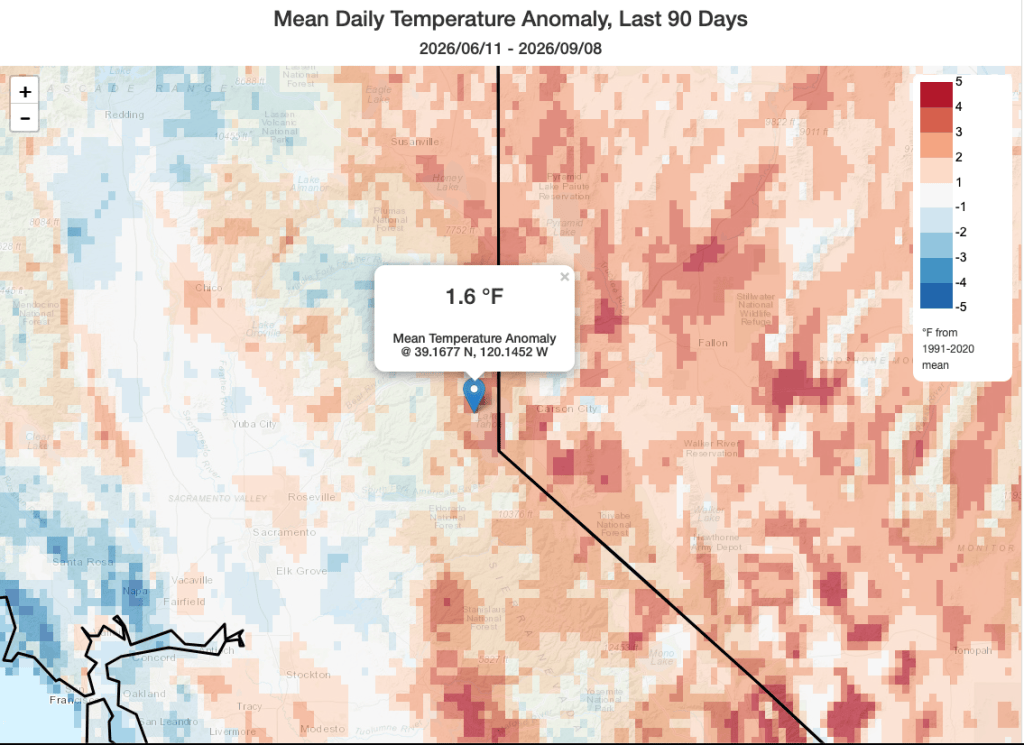
Backcountry weather across the Tahoe Sierra this summer has been generally pleasant and unremarkable, alternating between periods of warm and dry conditions, interrupted by multi-day intervals of monsoonal flow and occasional afternoon thunderstorms. While temps trended above average for June through August, periods of extended extreme heat were few and generally short-lived.
Mean temp. anomaly at Tahoe City from 6/11/26-9/8/26. Source: Climatetoolbox.org
Now that summer’s zenith is behind us, backcountry trail conditions have reached peak dust. A few recent systems brought localized rainfall around the end of August/beginning of September, but whatever moisture fell has long since evaporated, leaving plentiful moon dust that lofts at the slightest breeze or footstep. Meadow wildflowers long-since browned and gone to seed, are now replaced by the late summer soundtrack of crispy mules ear leaves, rustling in the breeze.
El Niño Update:
El Niño is here, and its impacts are already being felt. Anomalous sea surface warming across the eastern equatorial Basin intensified over the past few months, all but assuring a strong to very strong event continuing into the fall and early winter. Models are in nearly unanimous agreement for a powerful event that will likely create significant global impacts for the remainder of 2026 and into the first half of 2027.
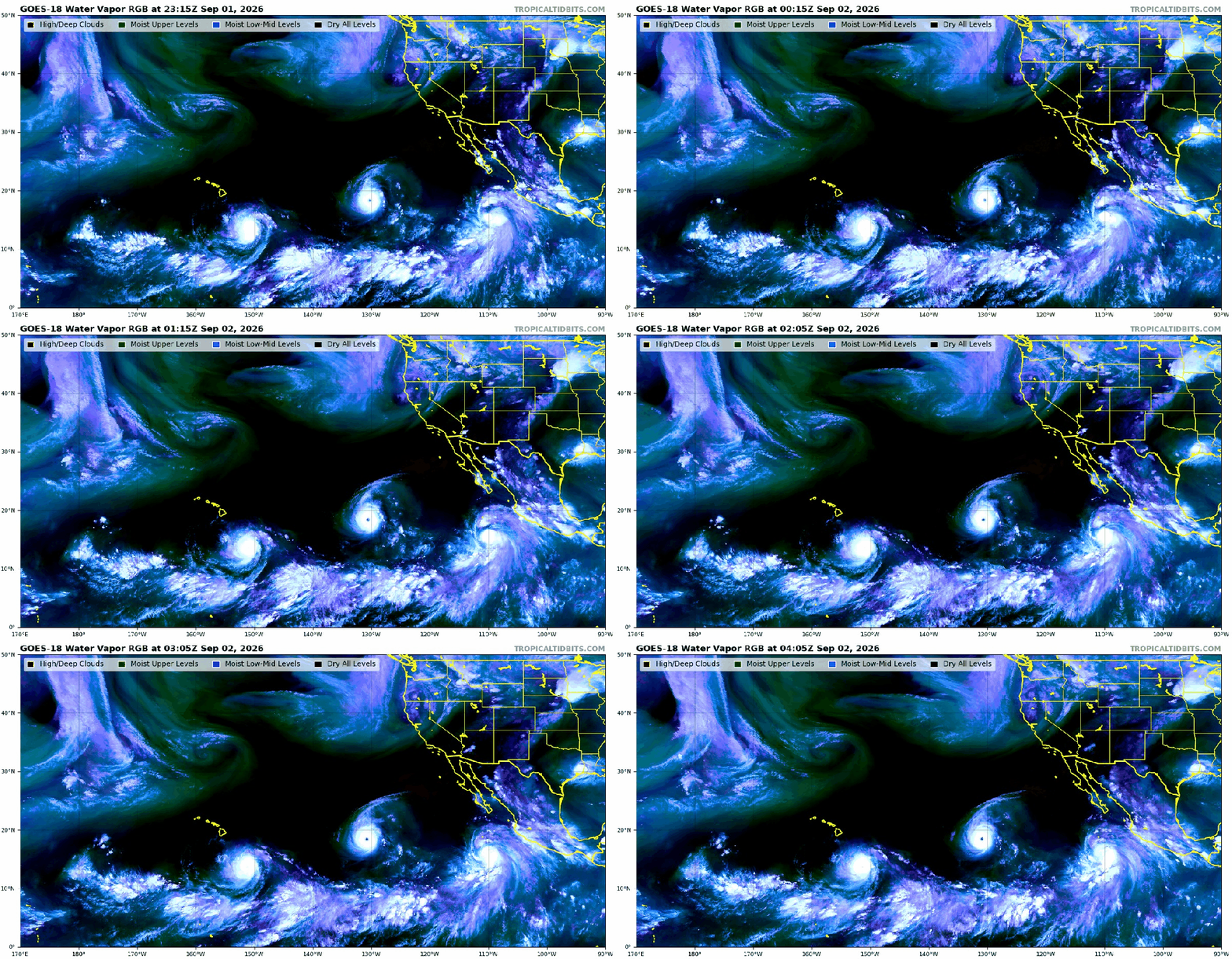
Already, hurricane season in the eastern Pacific has been supercharged by warm waters and low upper level wind shear, creating an ideal environment for tropical development. During the first week in September, a conga line of three hurricanes (Lowell, Karina, and Marie) stretched across the Pacific from Mexico to Hawai’i!
From west to east, Lowell, Karina, and Marie churn across the Pacific, fueled by unusually warm water temps, directly connected to El Niño. Source: Tropicaltidbits.com GOES 18 WV viewer.
Not only is the signature of El Niño obvious, but record warm sea surface temperatures (SSTs) now extend far north of the main Niño 3.4 region, even reaching the Southern California coast and Hawai’i, providing plenty of fuel for tropical systems.
SST anomalies across the Pacific Basin as of 9/8/26. Source: cyclonicwx.com
Warm ocean waters aren’t just fueling hurricanes in the tropics, they’ve made southern California feel more like Florida with hot and muggy afternoons and isolated thunderstorms. Remnant tropical moisture advecting northward has introduced unseasonable instability into the region, helping to fire off afternoon thunderstorms in the summer heat over the past few weeks.
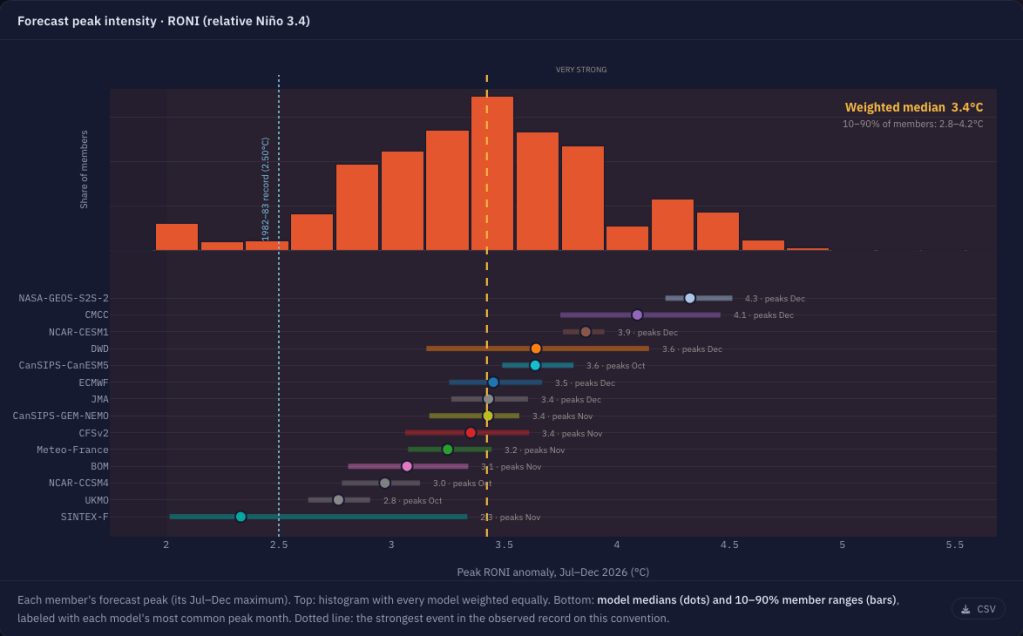
Looking ahead, models indicate further strengthening of El Niño going into the fall and early winter, likely peaking in record territory around Nov-Dec. The greatest share of forecast models predict a median relative (RONI) peak of 3.4°C above normal. To put this in context, the big 1982-1983 event topped out at 2.50°C.
Source: Climate Dashboard
Existing data and research suggest that strong, east-based El Niños tend to enhance the subtropical jet stream in the East Pacific and increase atmospheric water vapor and energy in winter, creating a favorable environment for an active storm train and above average precipitation across CA, especially in central and southern CA. For more on El Niño and its typical impacts on weather across North America, check out the explainer post from June.
Winter 2027 Outlook
Even as a strong El Niño is nearly certain for the remainder of the year, its exact impacts on the Sierra for the coming winter are anything but. El Niño might be the loudest of this season’s teleconnections, but other atmospheric phenomena will impact winter weather patterns, affecting Sierra storms throughout the season.
Furthermore, humans have never experienced an event of such intensity in a global climate ~1.5°C warmer than pre-industrial levels. It’s warmer this year than during any previous, recorded El Niño, and that will impact how things play out. Finally, the sample size with which climatologists are basing their understanding is small, dating back to only around the 1950s. Despite a world of technology, data, and professed certainty, there is still so much unknown in understanding the climate system. Interpreting a seasonal forecast with humility is good practice. This is uncharted territory.
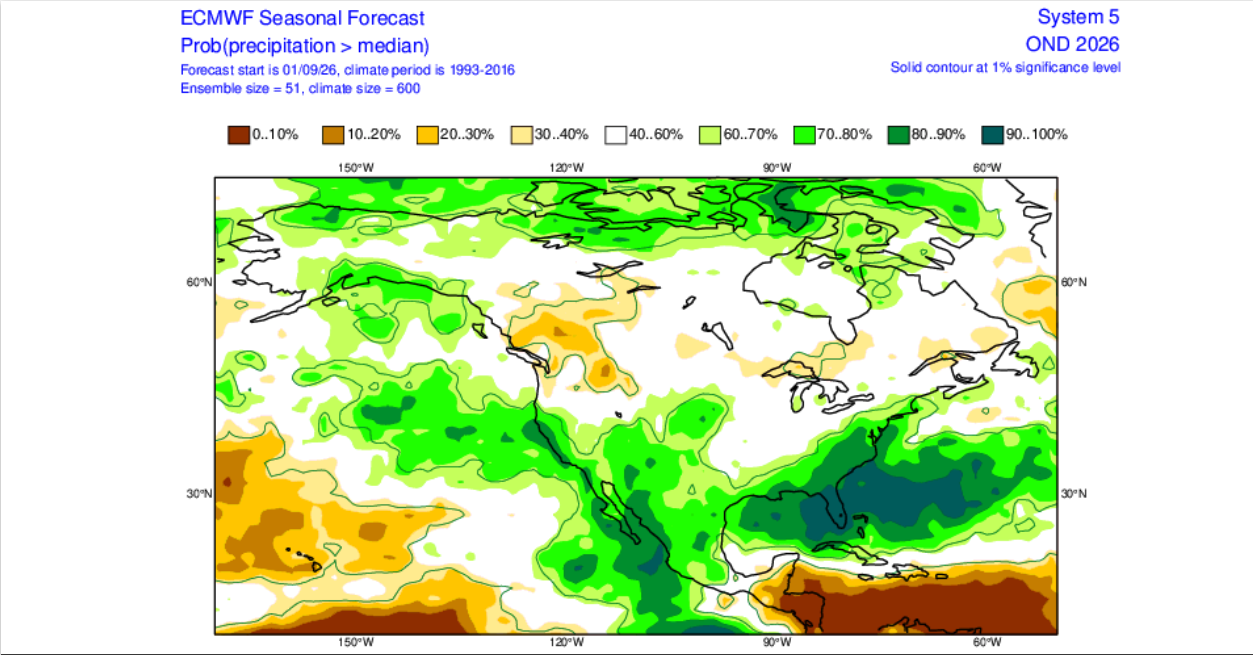
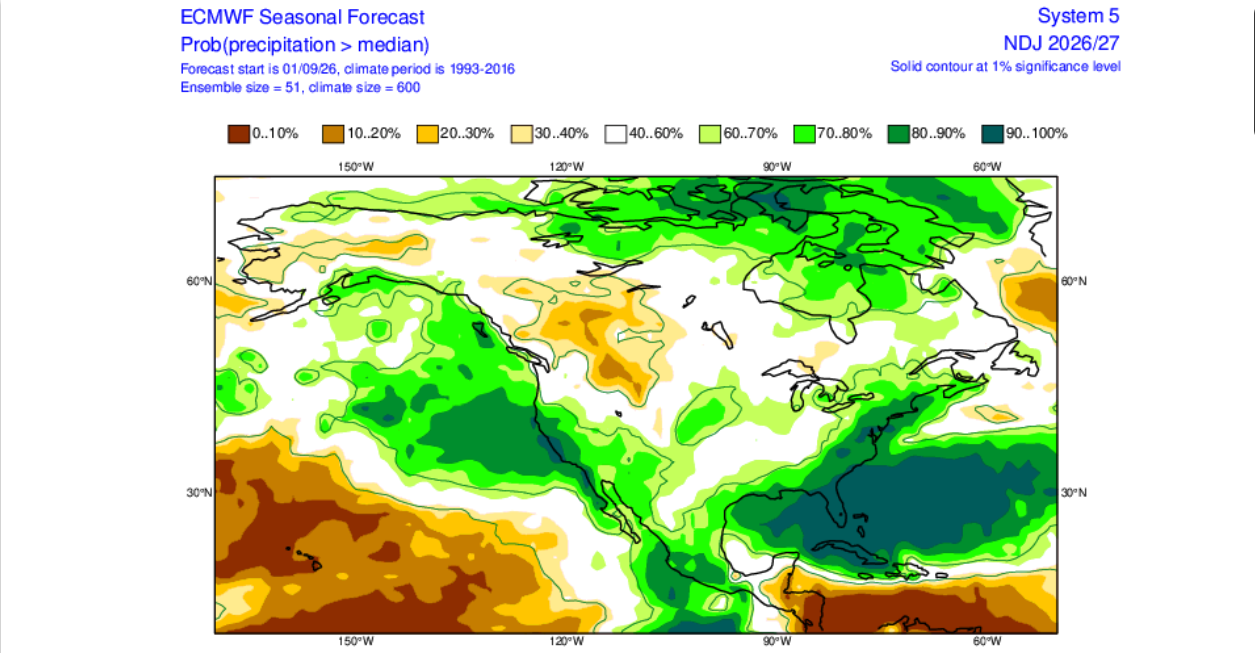
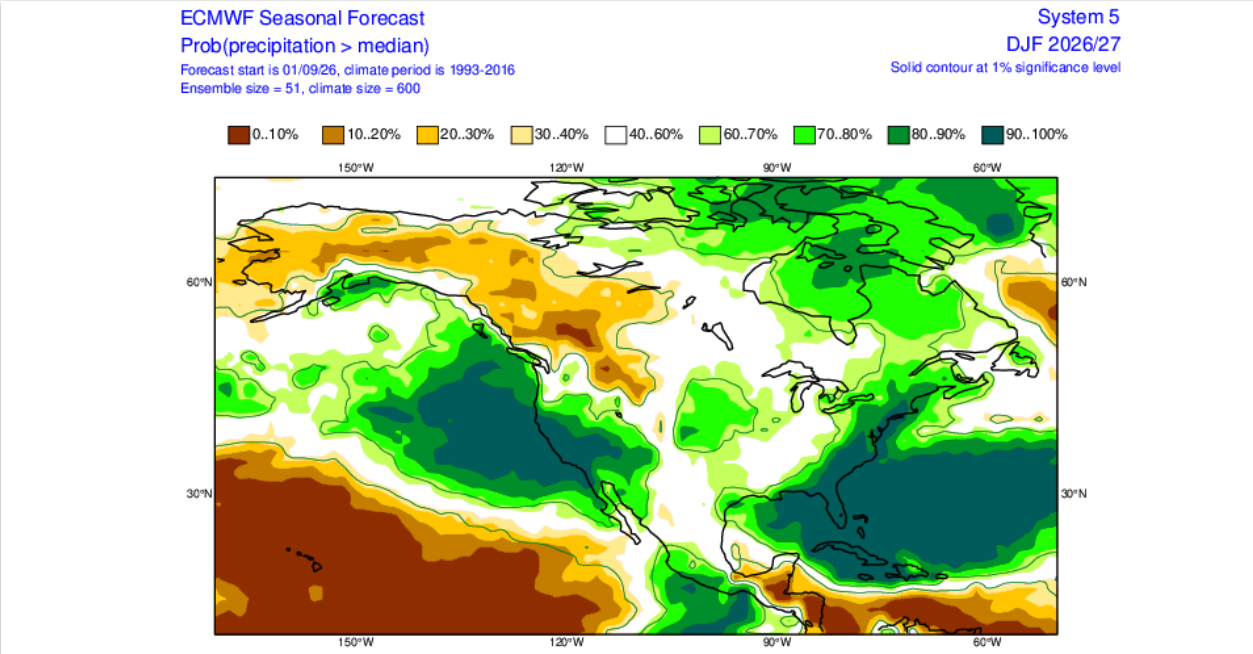
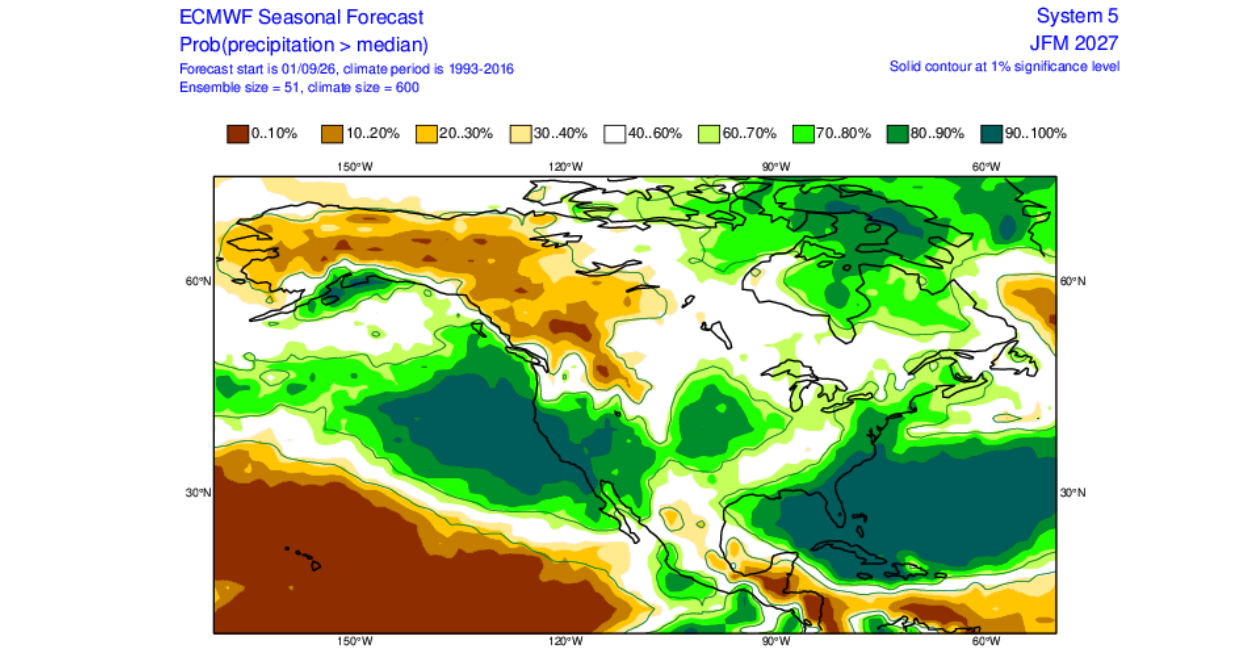
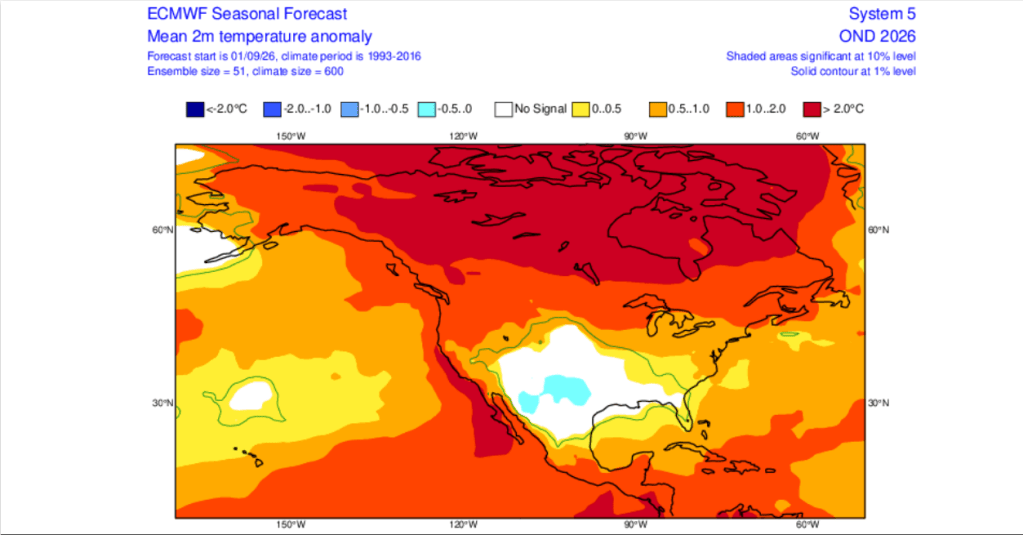
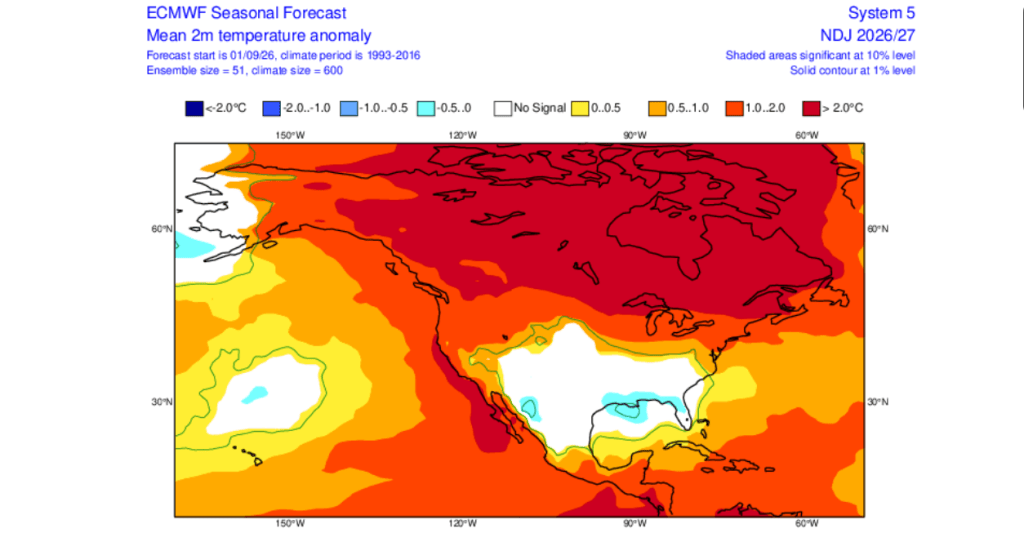
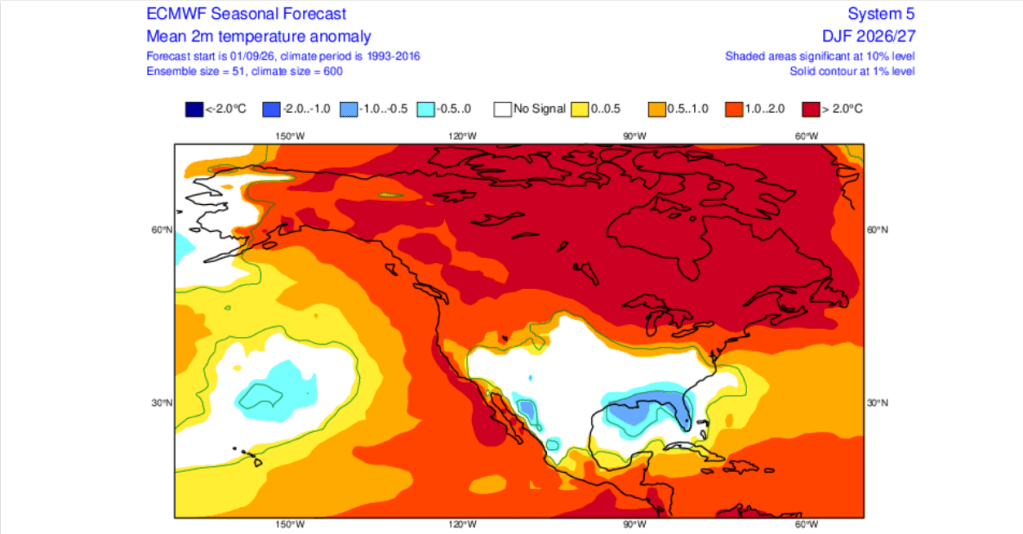
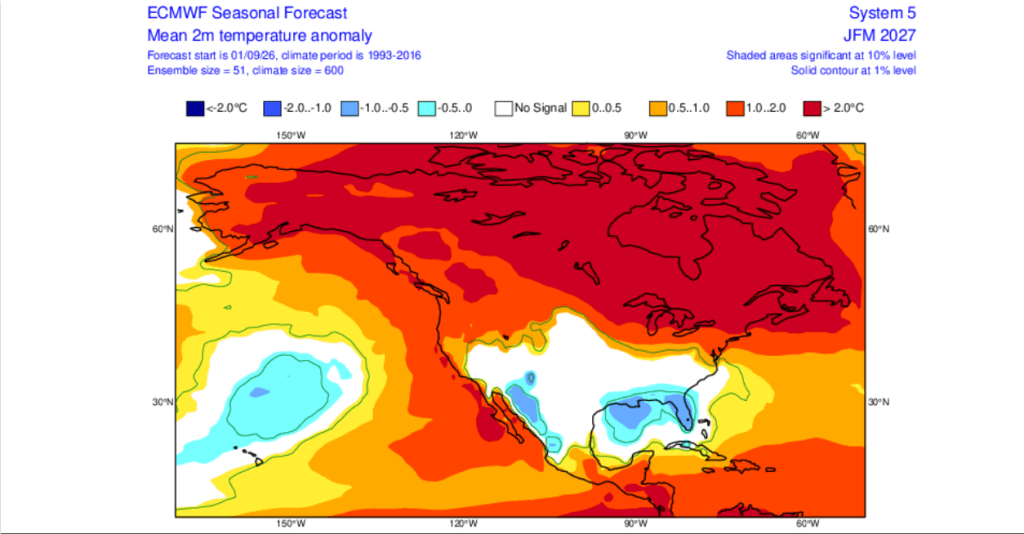
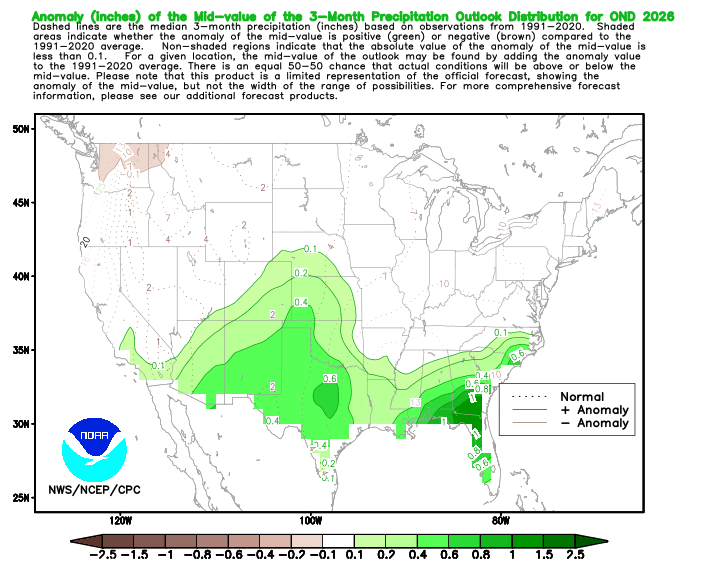
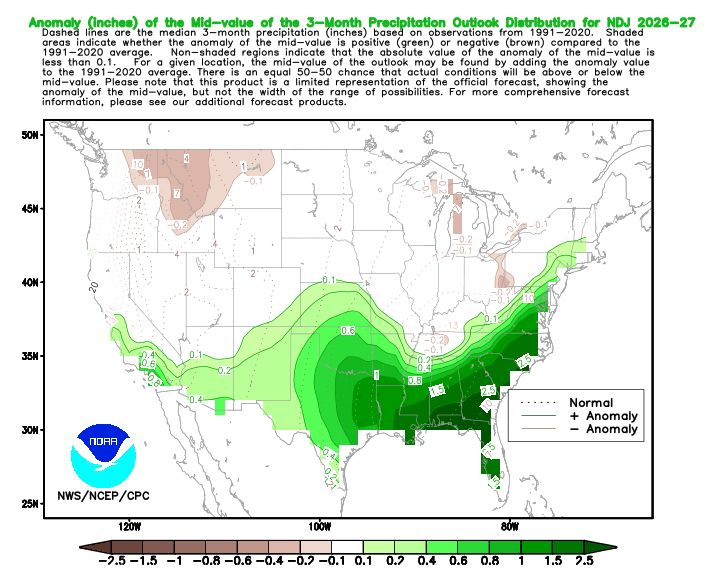
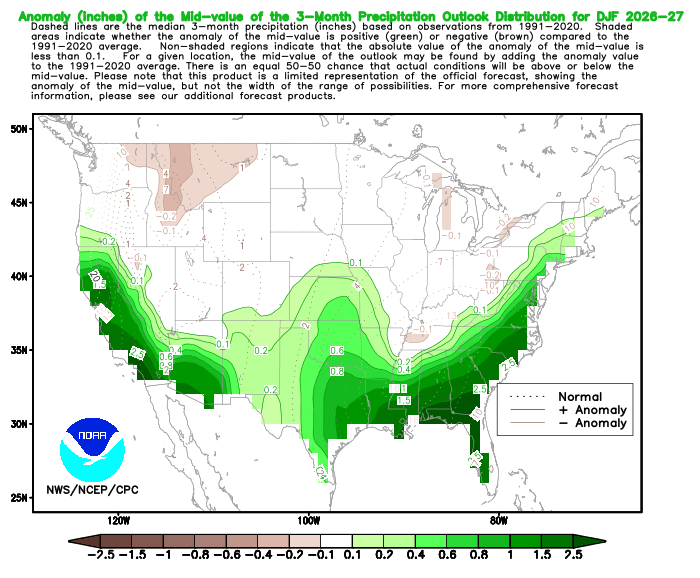
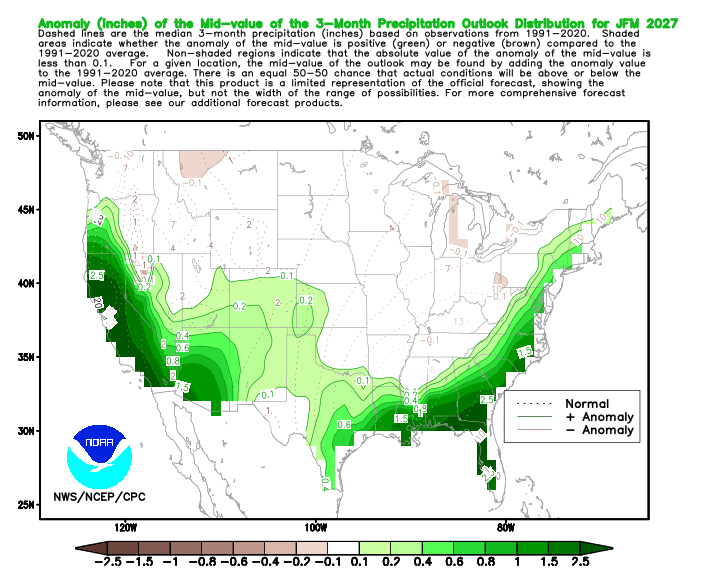
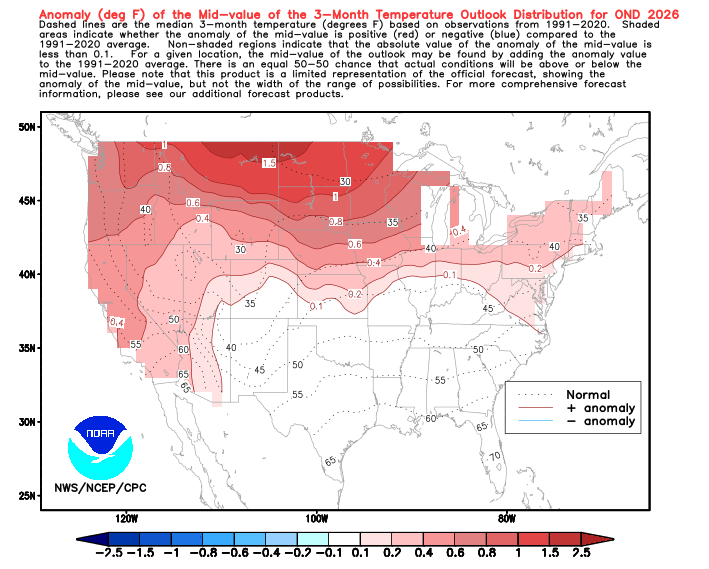
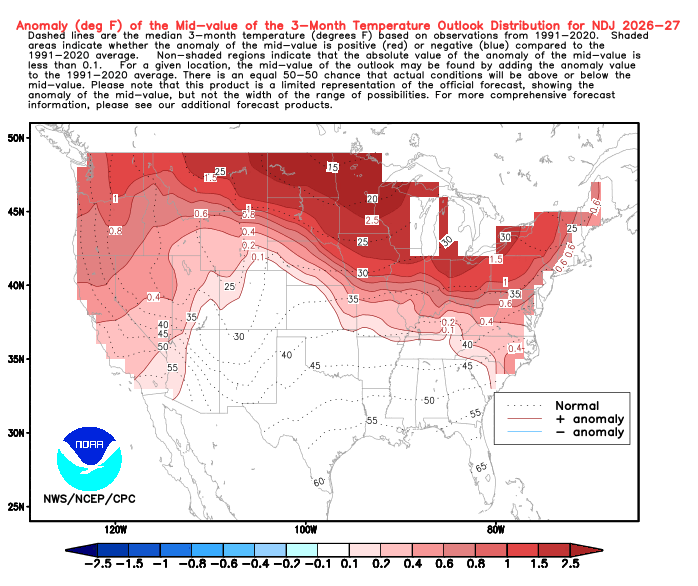
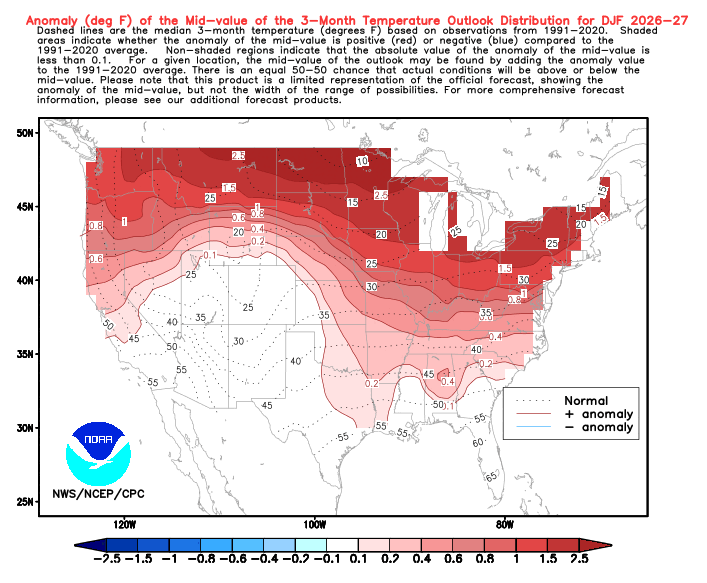
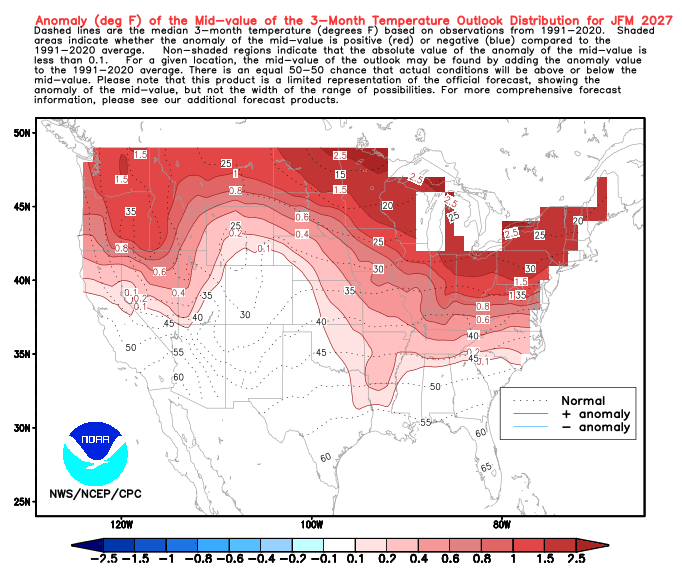
With the caveats covered, the Euro (ECMWF) and NOAA’s Climate Prediction Center (CPC) seasonal forecasts are out, which are beginning to shed some light on what could come to pass for the coming winter. Below is a slideshow of departures from normal probabilities for precipitation and temperature from the most recent early September runs of the ECMWF and CPC forecasts.
NOAA/CPC Probability of Exceedence (POE) Precipitation Forecast
Source: NOAA Climate Prediction Center
Source: NOAA Climate Prediction Center
Source: NOAA Climate Prediction Center
Source: NOAA Climate Prediction Center
NOAA/CPC Probability of Exceedence (POE) Temperature Forecast
Source: NOAA Climate Prediction Center
Source: NOAA Climate Prediction Center
Source: NOAA Climate Prediction Center
Source: NOAA Climate Prediction Center
While there are some differences in the models with regard to timing and intensity of the precip and temperature anomalies, both agree on an increased likelihood of a warmer and (much) wetter winter than normal.
What this all means and how it plays out is still anybody’s guess. One key factor will be just how much additional warmth from the ocean translates into higher snow levels, denser snow, and more rain vs. snow events. Will an enhanced storm track and more available moisture phase with cold air out of the Gulf of Alaska to produce monster dumps, even at lake level? Or will a pattern of warm atmospheric rivers emerge with high snow levels, washing out lower elevation zones?
Even before the last flakes of winter 2026 had fallen, predictions for winter 2027 already made headlines due to the probable return of the most-hyped atmospheric oscillation out there: El Niño.
The king of all El Niños: Chris Farley.
Hyperbolized monikers like “Super” and “Godzilla” are already running rampant across the web and in mountain town conversations throughout the Sierra. So is this real or hype? What impacts could this have on summer and winter across the Tahoe Sierra? And what is El Niño anyway?
El Niño Basics
El Niño is part of a natural, periodic warming of the eastern and central equatorial Pacific Ocean waters that occurs every 2-7 years as part of the ENSO (El Niño Southern Oscillation). Officially, sea surface temperatures between 5°N and 5°S latitude and 120°W to 170°W longitude (also known as the Niño 3.4 region) must surpass 0.5°C over the long term mean by 3 or more months. El Niño isn’t a raging storm or any single weather event, just anomalous warming of oceanic waters over an extended period. While El Niño and its causes are well known in the scientific community, there is still extensive ongoing research to help better understand what factors like oceanic circulations, trade wind slackening, Kelvin waves, climate change, etc. help set the stage for the phenomenon’s periodic return and iterative strength.
Moderate to strong El Niños can have significant impacts on the atmosphere in the tropics and beyond. Because the ocean and the atmosphere are so closely linked–the ocean is a direct source of atmospheric heat and water vapor– an upward shift in sea surface temperatures for an extended period, as occurs during El Niño, causes large-scale changes in the atmosphere in the Niño 3.4 region and beyond. At the most basic level, higher sea surface temperatures increase the potential energy of the atmosphere, promoting storm development in places that typically don’t experience it (eastern and central equatorial Pacific), while areas climatologically favored for convective storm development and rainfall tend to go dry (Western Pacific and Australia).
El Niño Teleconnections and California
The local changes to weather over the Pacific wrought by El Niño don’t stick to their own neighborhood. Much like ripples in a pond extend out across the water’s surface, so too do the atmospheric ripples caused by the shift in atmospheric pressure, temperature, and subsequent storm formation over the central and eastern Pacific. Connections between a persistent weather pattern in one part of the world affecting weather patterns elsewhere are called teleconnections. And it’s these teleconnections from El Niño that can have the greatest impact on the Sierra, primarily during the winter (Dec-Mar).
One major teleconnection with impacts on California during moderate to strong El Niño is a strengthening of the subtropical jet stream (STJ), the high altitude, high velocity steering winds between 35-40k ft. that circle the globe around 20°-30°N. Storms typically ride and develop along these currents which also serve as thermal boundaries between air masses. Jet streams garner their power from steep temperature gradients in the atmosphere. In midwinter, the difference between the constant warmth of the tropics and the deepening cold of the mid to upper latitudes reaches its zenith, seasonally enhancing the strength of the STJ.
During El Niño, the STJ strengthens even more than normal in response to a greater thermal gradient between the tropics and higher latitudes, especially across the Pacific and North America. This raises the likelihood of the winter storm track digging further south into CA and the SW along the enhanced STJ, increasing the odds of more frequent storms coming ashore into Central and Southern California.
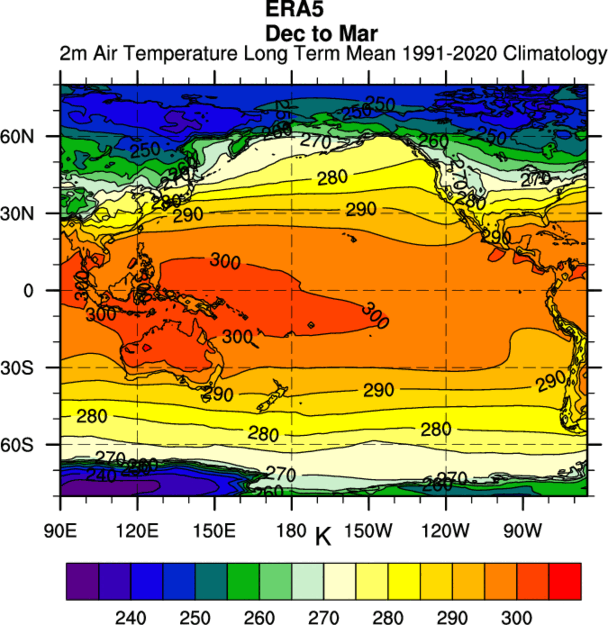
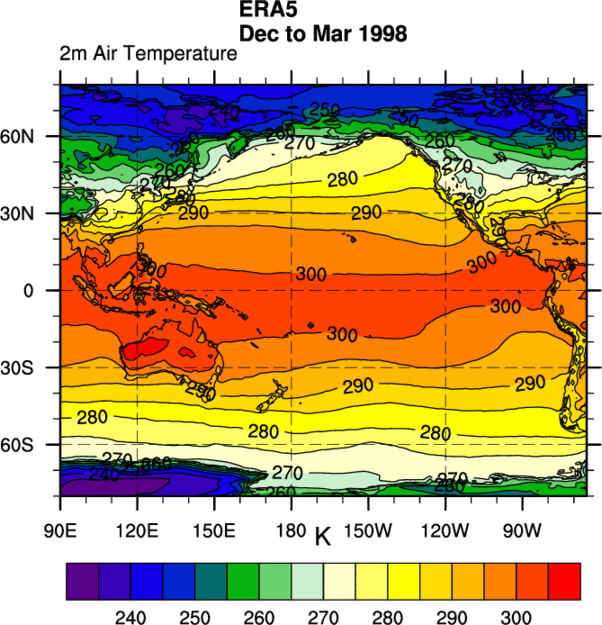
2m climatological (1991-2020) baseline for average air temperatures across the Pacific Basin in degrees Kelvin from Dec-Mar. For reference, 300K is around 80°F. (Courtesy NOAA Physical Sciences Laboratory)Dec-Mar 1998 2m mean air temperatures across the Pacific Basin in degrees Kelvin. For reference, 300K is around 80°F. (Courtesy NOAA Physical Sciences Laboratory)
Notice the tongue of 300K temps stretching all the way across the tropical Pacific into Central America in winter 98′. This surge of heat also created a greater north-south temperature gradient between the tropical Pacific and the mid latitudes to the north.
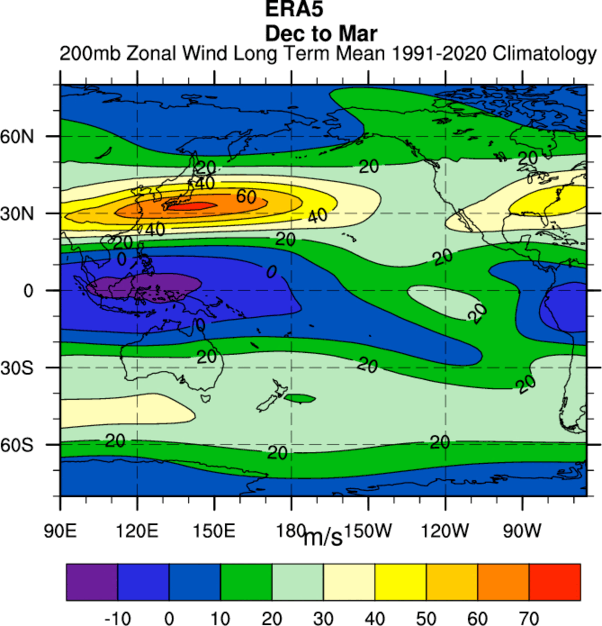
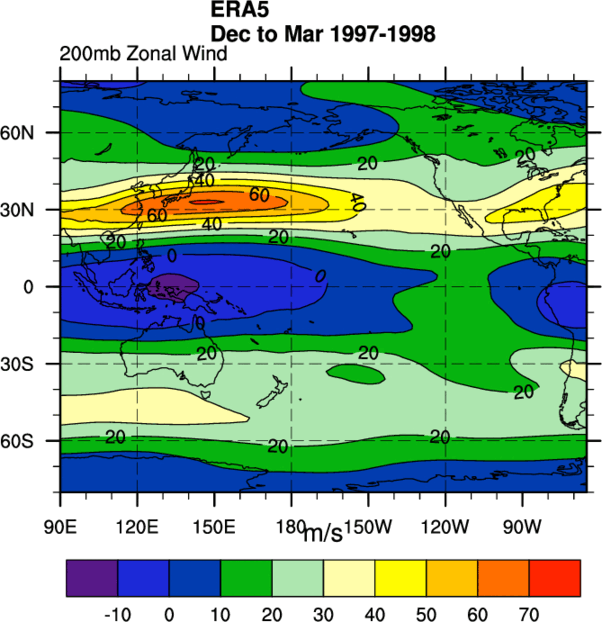
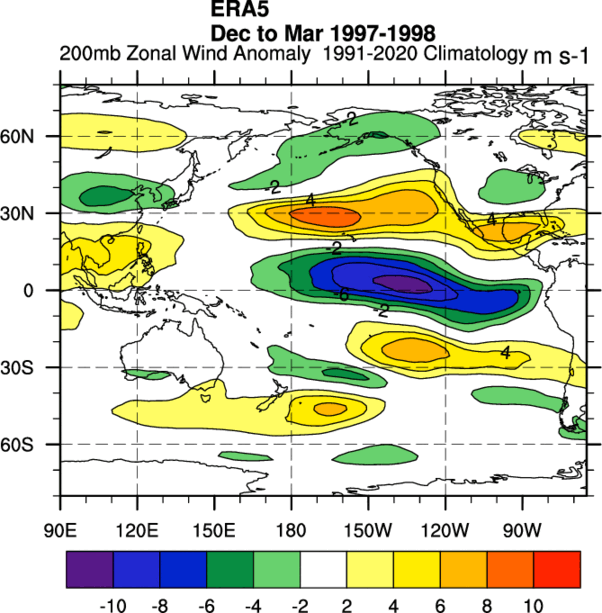
The greater temperature gradient near the surface extended upward throughout the atmosphere, enhancing the strength of the STJ. Below is data showing the typical mean strength of the STJ from Dec-Mar, followed by the actual strength of the STJ from Dec 97′-Mar 98′, and the strength of the anomaly observed for that season.
Dec-Mar 1998 200mb (~39,000′) average climatological wind speeds across the Pacific Basin in m/s. Roughly doubling the m/s value equates knots. Notice the strong values coming off East Asia into the Pacific and the elevated values over the Eastern US. (Courtesy NOAA Physical Sciences Laboratory)Dec-Mar 1998 200mb (~39,000′) observed mean wind speeds across the Pacific Basin in m/s. Roughly doubling the m/s value equates knots. Notice the strong values coming off East Asia into the Pacific, extending further east towards the West Coast of the US and connecting with the enhanced subtropical jet over the SE US. (Courtesy NOAA Physical Sciences Laboratory)Dec-Mar 1998 200mb (~39,000′) observed wind anomalies expressed in standard deviations from normal. Notice the enhanced values across the central and eastern Pacific and into CA, evidence of an enhanced STJ throughout the winter. (Courtesy NOAA Physical Sciences Laboratory)
In response to the greater thermal gradient across the Pacific Basin, the STJ responded with increased intensity and range across the Pacific and into CA. Also worth noting is that the elongated STJ slowed down near CA, placing CA in a region of upper level conditions favorable for storm formation for prolonged periods during the winter months.
While an enhanced STJ promoting a more active storm track into CA is a classic El Niño teleconnection, the phenomenon comes in many strengths and flavors, all of which can greatly affect the local impacts from year to year. Should anomalous SSTs occur further west in the Pacific, impacts to CA can change drastically. (The 97-98′ and 82-83′ strong El Niños produced significantly above average winters in the Sierra, while the 2015-2016 event, still quite strong, ended up being more of a yawn for the Sierra and snowpack.)
El Niño: not the only player
ENSO is also not the only teleconnection that affects weather in the Tahoe Sierra. Other teleconnections across the globe have their own constructive or destructive influence on the impacts of El Niño. While ENSO is significant, it’s far from the only predictive signal for winter precip. Further complicating the scene, the atmosphere is now significantly warmer than it was even just a decade ago. In fact, the earth is twice as warm as it was in 1998. The additional warmth in both the tropics and the mid and upper latitudes will have significant–and not yet entirely understood–impacts on El Niño and its teleconnections going forward. It’s a complicated picture.
What is increasingly clear for the Sierra is that a warmer atmosphere will generally produce warmer storms with higher snow levels. If SSTs in the Pacific are warmer than average, that heat energy will be transferred into the atmosphere, creating generally warmer storms with a greater capacity for heavy precip. Tahoe could receive above average precipitation in a strong El Niño event, but much of that might fall as rain, especially at mid to lower elevations in the Basin (6000-8000’). Even without El Niño, winter 2026 ended up being an example of such a scenario with a snow drought for elevations below 7000′, while higher terrain, especially above 9000′ ended up with snowfall totals closer to normal.
Current conditions and El Niño forecastfor winter 2027
With the basics of El Niño and how it can impact the Sierra covered, where do things stand now? And what strength and flavor of El Niño could form this winter?
Currently, SSTs across the Pacific Basin are already well above average. There’s even an ongoing marine heatwave across the E Pacific that’s been building for the past few months, completely unrelated to ENSO, which may have played a significant role in the cool, wet April and series of weekly storms throughout this past spring.
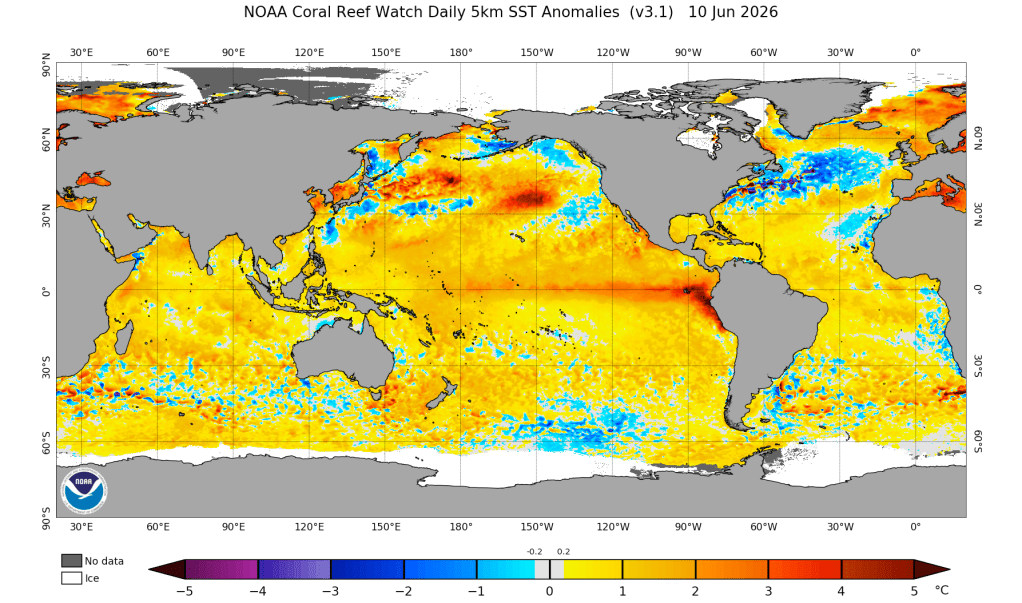
Sea surface temperature (SST) anomalies as of 6/10/16. Note the developing El Niño along the west coast of South America, extending along the equator towards the date line. The eastern Pacific marine heatwave is visible as a triangle of yellow and orange values extending from the SoCal coast SW into the Pacific and along the Mexican coast.
Signs of an emerging El Niño are already taking shape as waters along the Ecuadorian and Peruvian coasts are 3-5°C above average and a tongue of 2-3°C waters is emerging along the equator, extending westward out to around 120°W and even beyond. The classic “light sabre” of anomalously warm waters extending from South America out into the Pacific is already coming into view. Will this continue developing throughout the summer and into the fall?
Forecasts for El Niño’s development are in strong agreement for a significant event, as noted in the latest ECMWF (Euro) ensemble member forecasts.
June 1 ECMWF relative ENSO 3.4 SST anomaly forecast. Each line represents an individual forecast model showing the sea surface temperature anomalies forecast from early spring 2026 through Feb. 2027.
The blue dashed line and pixelated red plume indicate actual observed and projected anomalies to date. SSTs are already climbing in a steep, upward trajectory. As we move out in time, the strength of the event is less certain with greater spread in the models, but by late fall all model members are between 2-3°C, a significant event. There are no members not predicting an El Niño, while quite a few go out to 3-4°C, which would be a very intense event. What’s also significant about this forecast is that it shows a “relative” Niño anomaly, representing how significant the SST anomaly is in the context of current conditions that are already warmer than average due to long term background warming. To learn more about the relative indices, check out this NWS/NOAA explainer.
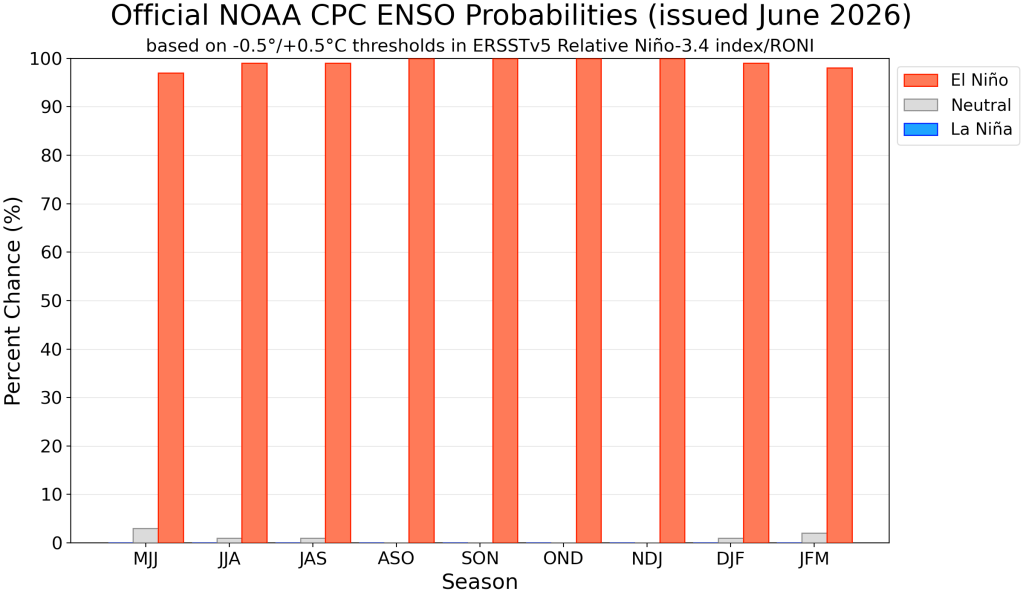
Forecasts from the Climate Prediction Center show this near certainty of El Niño quite strikingly in their most recent June ENSO probabilities and strength forecasts. Between May and June, CPC forecasts leaned even harder into both the near certainty of El Niño for the coming fall and winter, and the likelihood of a very strong event.
El Niño probabilities by 3 month period from May 2026 through March 2027 issued June 11, 2026. Courtesy of the NOAA Climate Prediction Center.
Like the Euro ensembles above and current SST observations, El Niño is nearly certain for the remainder of the coming year and into next winter. Seasonal and subseasonal probability forecasts with such high probabilities are exceedingly rare.
The latest June intensity forecasts for El Niño have also trended heavily towards a very strong event since the May advisory.
El Niño strength probability forecast from April 2026 through February 2027 issued May 11, 2026. Courtesy of the NOAA Climate Prediction Center. El Niño strength probability forecast from May 2026 through February 2027, issued June 11, 2026. Courtesy of the NOAA Climate Prediction Center.
The darker bar at the top of is the likelihood of a very strong event, greater than 2.0°C. Starting in the late fall (October, November, December) chances of a very strong event have doubled since the May advisory! Probability forecasts in May were ~30% and have since climbed to more than 60% and continue into the November – December – January time frame. Forecasts in May were impressive, but this month’s update is even more eyebrow raising. It’s not often that seasonal forecasts this far out are in such alignment and continue trending heavily towards such an extreme outcome.
What does all this mean for the coming season in Tahoe? It’s impossible to say exactly, but with what we know, strong odds for a very strong El Niño do increase the odds of a few things happening.
For the coming summer, warmer than average waters over the tropical Pacific will increase the amount of energy available for tropical cyclone development. This will likely lead to a more active than normal East Pacific hurricane season with more atmospheric “fuel” available for more intense storms. In recent weeks, a few tropical storms have already formed off the SW coast of Mexico in the area of the current, marine heatwave. As waters warm and expand northward with the developing El Niño, they will merge with the current marine heatwave, creating even more favorable conditions for stronger and more numerous tropical storms and hurricanes.
What does this have to do with CA? Moisture from these systems could get pulled northward into CA and the desert SW, increasing the chances for afternoon thunderstorms in late summer and early fall. But the flavor of thunderstorms is a big unknown and won’t be clear until days or even hours before they form. Wet storms could bring beneficial rains, helping to temper fire season concerns. Dry storms could ignite vegetation, complicating fire concerns. The widespread fires in CA in late summer of 2020 were largely ignited by dry lightning strikes caused by similar (non El Niño-related) transport of moist, tropical, low and mid level flow into California, causing high-based, dry thunderstorms.
Across Tahoe a key factor will be just how much cold air is able to mix in to any given system. The Tahoe region already sits right along the rain/snow line, and with more heat in atmosphere, snow levels will likely continue to be higher more often than not. Rain up to 7000′ is now a fairly common occurrence. But should the storm track align such that cold air from the Gulf of Alaska phases with enhanced subtropical moisture, lower snow levels and heavy snow would result. This far in advance, discussion of details is nothing more than speculation.
Godzilla may not rise out of the sea later this year, but active and impactful weather later this summer and into next winter look increasingly likely for California and the Sierra. El Niño hyperbole isn’t just on the internet and in mountain town chatter, it’s also appearing in the data.
There’s fresh snow out there. Daily thunderstorms from the most recent storm dropped a few inches of snow at the highest elevations, mainly above 9000′. The storm system responsible for the unsettled weather arrived on Sat (5/2), triggering a daily barrage of showers and storms through today (5/5). Snow levels during the event started high, then dropped to nearly 7000′ by the evening of 5/4, and by midnight, a few inches of snow had fallen across the Mt. Rose area above 7500′. Despite the fresh snow, it mainly fell on dirt except at the highest elevations and in N facing zones where access now requires hiking in, before reaching a continuous, skiable snowpack.
Trail conditions below 8000′, however, are currently excellent–and fragrant too with the multitude of flora bursting forth for the season. Daily rainfall since Sat (5/2) has been generally light to moderate with .10″-.50″ falling each afternoon, tamping down dust and creating a soft, springy surface on which to run, hike, or carve by bike. Below 8000′, trails are generally open with the occasional snow patch on shady N facing terrain. Above 8000′, and along the west side of the lake above 7000′, trails are still snow covered, but quickly burning out.
The recent rains and retreating snowpack make for an abundance of water flowing in most creeks and rivers, yet at moderate, past peak flows, facilitating simple, stress free creek crossings. Because peak melt already passed in late March and early April in response to the multi-week March heatwave, stream flows will steadily decline with spring’s progression.
Weather and forecast thoughts:
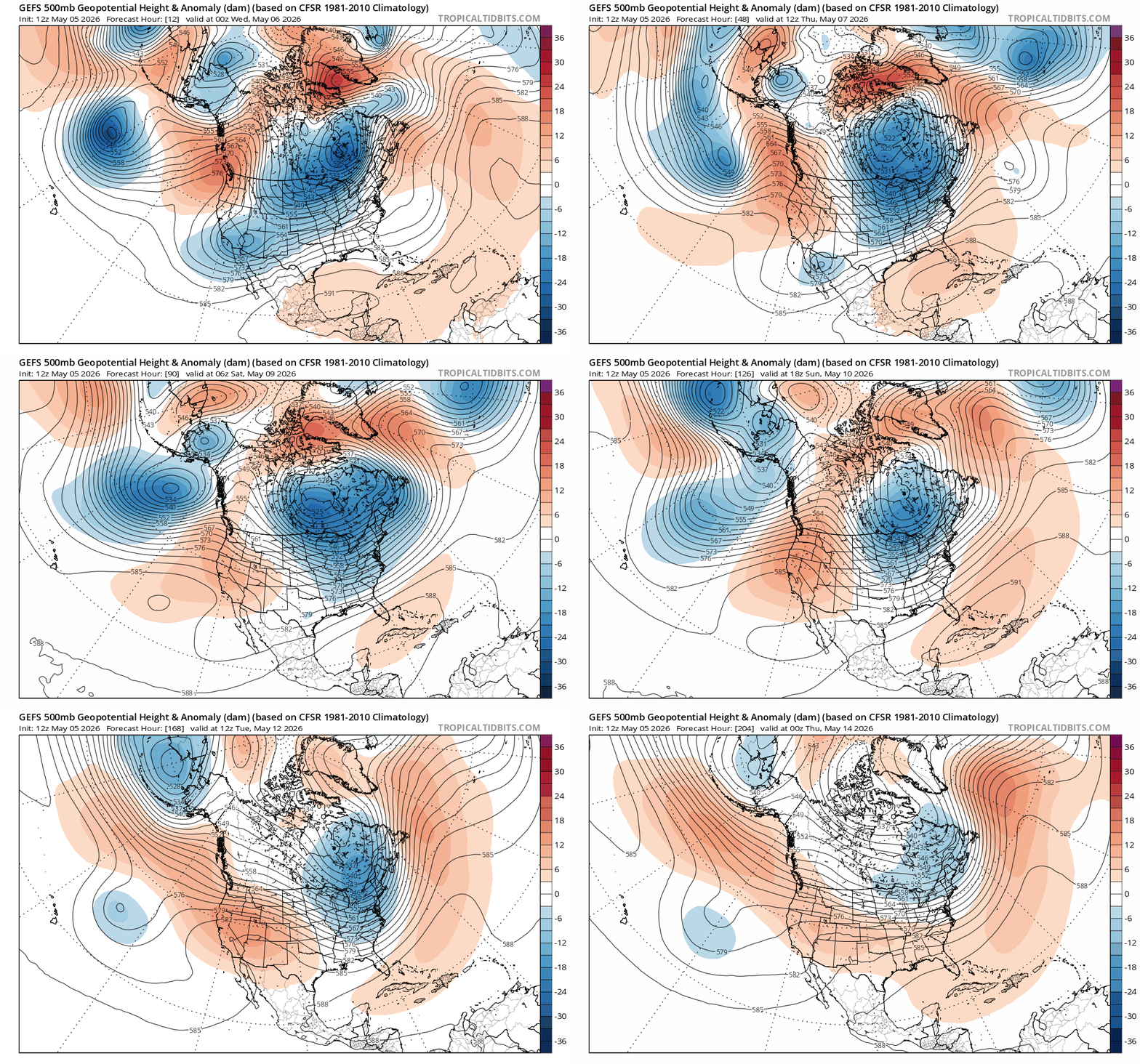
The storm system responsible for firing off daily storms since Sat (5/4) will finally move out of the area this evening (5/5), setting the stage for sunny skies and warm temps for the remainder of this week and the coming weekend. Beyond next weekend, models are in good agreement for even more warmth and sunshine as robust ridging builds in across CA into the week of May 11th.
The stubborn, cut off low that has meandered off the CA coast since the weekend created some impressive storms and rainfall across Tahoe. Storms brought a mixed bag of lightning, hail, graupel and even snowfall on Monday evening. I even received a report of a backcountry traveler in Johnson Canyon having to shelter from nearby lightning on Sun afternoon (5/3)!
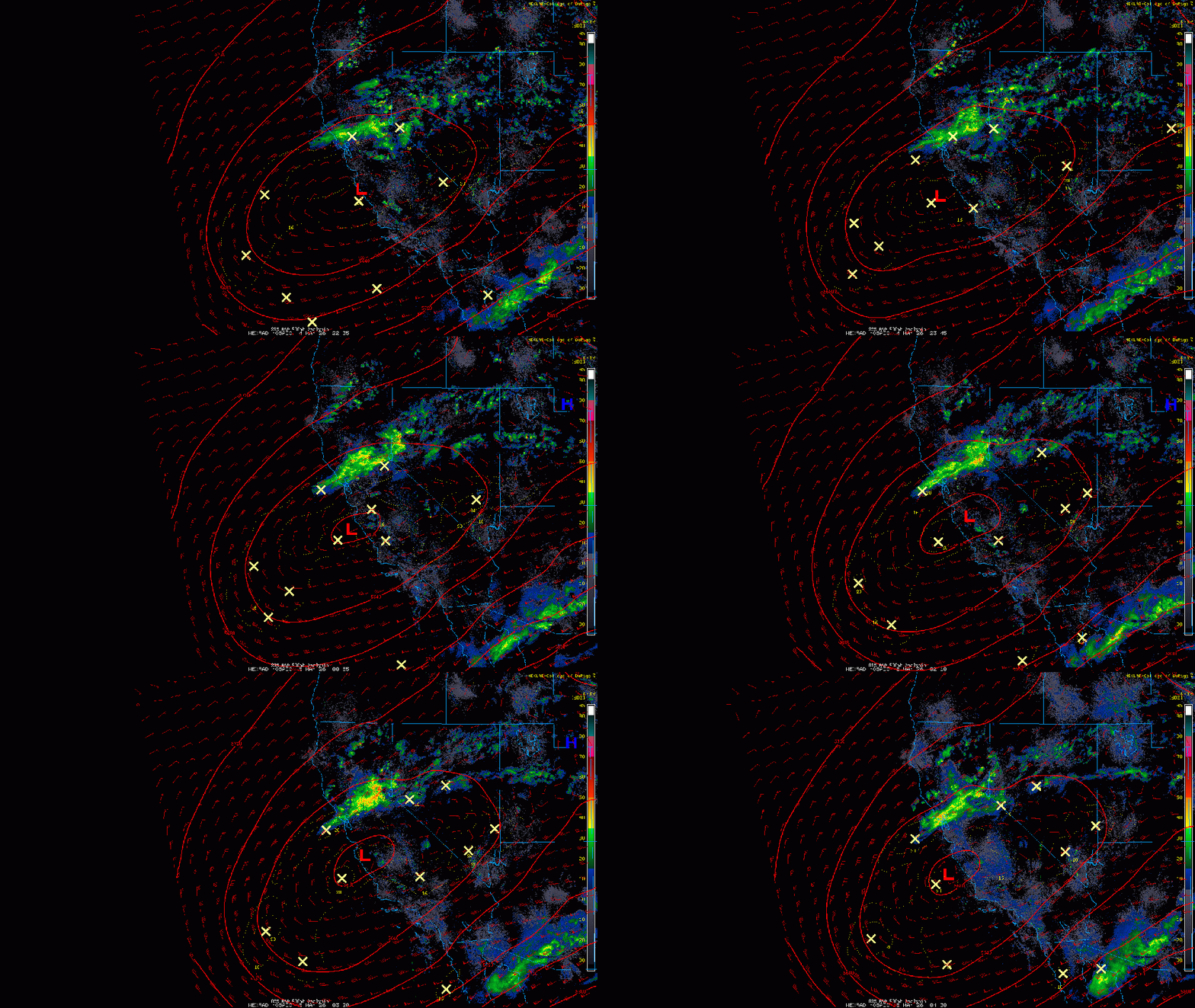
The heaviest and most consistent rain set up on Mon (5/4/) as a deformation zone formed right over Tahoe and the I-80 corridor, bringing a train of heavy showers and storms that transitioned to a wet snowfall late in the evening above 7000′. By Tues morning, the rain and 2″ of snow melted down to a total of 1.08″ of liquid at a 7650′ remote sensor above Incline Village.
Radar with superimposed 500mb wind and geopotential heights showing the upper level low pressure and resulting band of NE-SW moving heavy showers on Mon, 5/4/26 between 4:00pm-9:30pm.
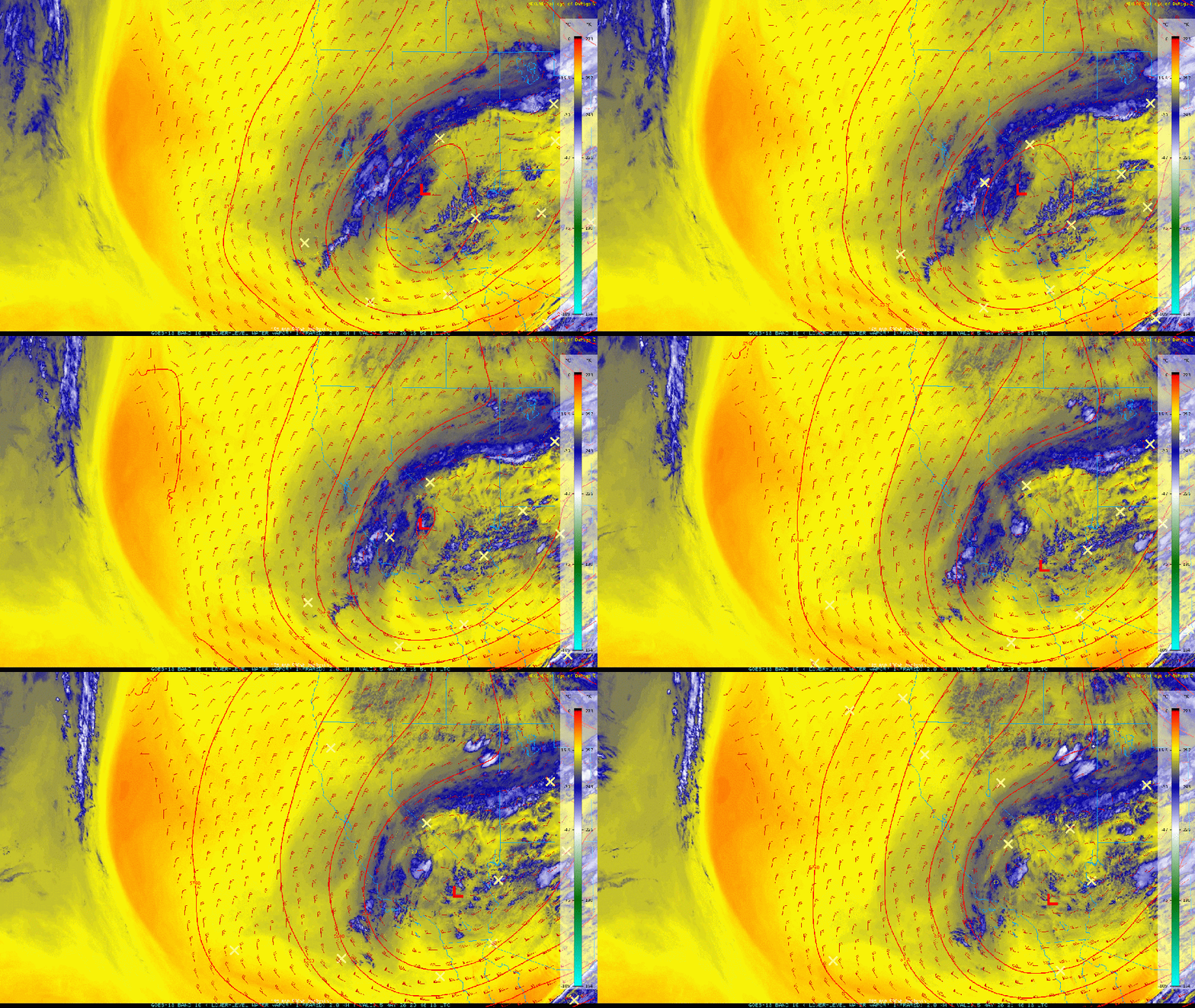
This evening the low pressure responsible for the active weather is finally moving off to the east. In its wake, clearing skies and cool overnight lows are expected tonight with lows in the low 40s in the mountains, with mid-upper 40s around the lake and in Truckee. Dense morning fog is possible for valley floors tomorrow (5/6) as abundant low level moisture and calm, clear conditions provide an ideal setup for nocturnal radiation fog.
Low level water vapor imagery showing the low pressure system shuffling to the south and east throughout the morning and afternoon on 5/5. Note drier low level air filtering in across Tahoe.
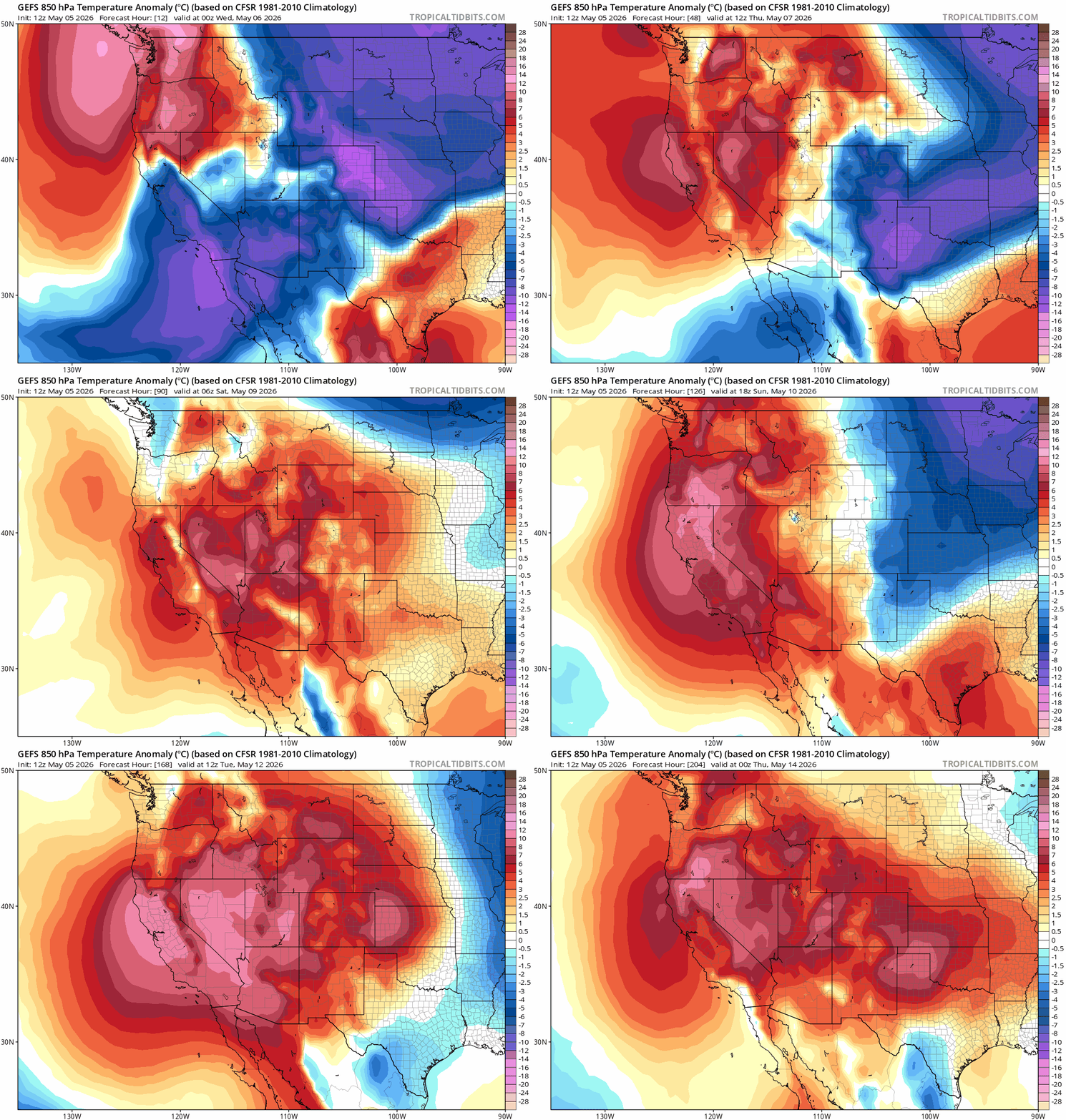
Tomorrow (5/6) high pressure begins to build over the area keeping skies clear and boosting afternoon temps. Highs will reach the mid- upper 50s above 7000′ with 60s in mountain communities. As the week wears on, temps will climb a few degrees each day going into the Mother’s Day weekend with highs into the 60s in the upper elevations with low – mid 70s possible around the lake.
Nighttime lows throughout the period look to cool efficiently each night in the dry airmass under mostly clear skies. Where snowpack does persist at the highest elevations (around and above 10k ft), a weak corn cycle may still hold on across open N facing slopes and bowls.
850mb (~5000′) temp anomalies from 5/5 at 5:00PM PDT to 5/13 at 5:00PM PDT showing anomalous May heat building over CA.
Looking out into next week, model ensembles show good agreement in the ridge of high pressure peaking early before gradually ebbing later in the week.
GEFS ensemble for 500mb heights from 5/5 at 5:00PM PDT – 5/13 at 5:00PM PDT showing a building ridge of high pressure over CA.
In response, temps will likely peak during the first half of the work week before cooling off towards the weekend with little chance of any precip during the period.
After nearly a month of warmish weeks and cool, unsettled weekends, the pattern looks to finally flip this coming week heralding spring’s arrival to the mountains.





 Tahoe Backcountry Snow